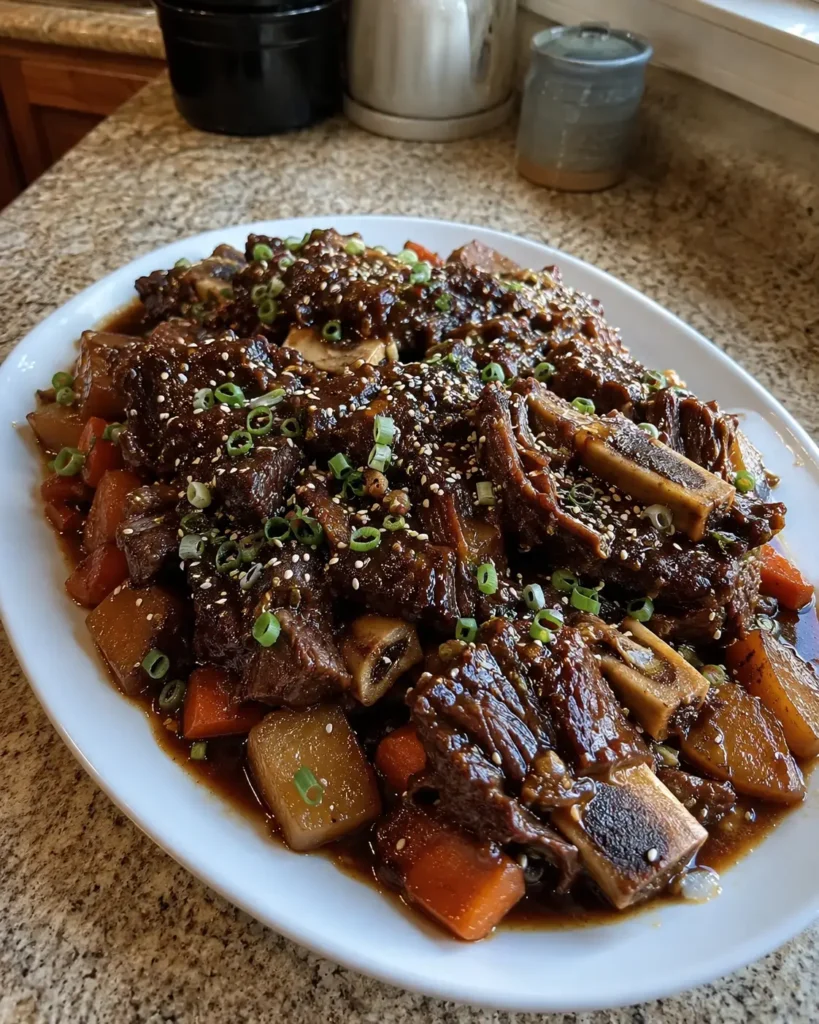
Slow Cooker Korean Short Ribs turn thick beef ribs into a tender, glossy dinner flavored with soy sauce, Asian pear, garlic, ginger, sesame oil, and gentle sweetness. The slow cooker does most of the work while the connective tissue softens and the sauce becomes deeply savory.
Slow Cooker Korean Short Ribs are galbi-jjim-inspired but streamlined for an American home kitchen. Serve the ribs with hot rice and vegetables, and save or print the recipe so the timing and doneness cues are easy to check.
Quick This Slow Cooker Korean Short Ribs Snapshot
| Detail | Information |
|---|---|
| Prep time | 20 minutes |
| Cook time | 8–9 hours on LOW |
| Total time | 8 hours 20 minutes to 9 hours 20 minutes |
| Servings | 6 |
| Serving size | About 1 large meaty rib plus sauce and vegetables |
| Difficulty | Easy |
| Cooking method | Slow cooker |
| Flavor | Savory, garlicky, gently sweet, sesame-rich |
| Texture | Fork-tender beef with glossy sauce |
| Best for | Family dinners and make-ahead meals |
Table of Contents
Why You’ll Love This Slow Cooker Korean Short Ribs
- Mostly hands-off: After assembly, the long cooking period needs little attention.
- Balanced flavor: Soy, pear, garlic, ginger, vinegar, and sesame build sweet-savory depth.
- Beginner-friendly: Fork tenderness and bone release give clear doneness cues.
- Family-style: Rice and vegetables turn the ribs into a full dinner.
- Make-ahead friendly: Chilling makes the rendered fat easy to remove.
- Useful leftovers: Extra beef works well in rice bowls, wraps, or burritos.
Ingredients and Why They Matter
Use 4 pounds bone-in English-cut beef short ribs, preferably 2–3 inches thick. Their marbling and connective tissue become tender during long, moist cooking.
Asian pear brings mild fruit sweetness, while soy sauce supplies salt and umami. Garlic, ginger, onion, sesame oil, mirin, and rice vinegar round out the sauce.
| Main Ingredient | Purpose | Nutrition Contribution | Best Substitution |
| Beef short ribs | Rich braising cut | Protein, iron, fat | Boneless short ribs |
| Low-sodium soy sauce | Salt and umami | Sodium | Lower-sodium tamari |
| Asian pear | Sweetness and body | Carbohydrates, some fiber | Bosc pear |
| Carrots | Sweetness and texture | Fiber, beta-carotene | Parsnips |
| Daikon | Mild fresh flavor | Carbohydrates, fiber | Turnip |
| Brown sugar | Balances salty notes | Added sugar | Honey |
| Sesame oil | Toasted aroma | Fat | Omit if unavailable |
For the sauce, combine ¾ cup low-sodium soy sauce, ½ cup beef broth, 1 peeled Asian pear, ½ yellow onion, ⅓ cup brown sugar, ¼ cup mirin, 2 tablespoons rice vinegar, 6 garlic cloves, 1 tablespoon grated ginger, 1 tablespoon toasted sesame oil, and ½ teaspoon black pepper. Add 3 carrots, 8 ounces daikon, 4 scallions, and sesame seeds.
How to Make Slow Cooker Korean Short Ribs
- Prepare the ribs. Pat the ribs dry and trim only large exterior fat deposits. Use fully thawed beef; USDA Slow Cookers and Food Safety recommends thawing meat before placing it in a slow cooker.
- Blend the sauce. Blend the soy sauce, broth, pear, onion, brown sugar, mirin, vinegar, garlic, ginger, sesame oil, and pepper until mostly smooth.
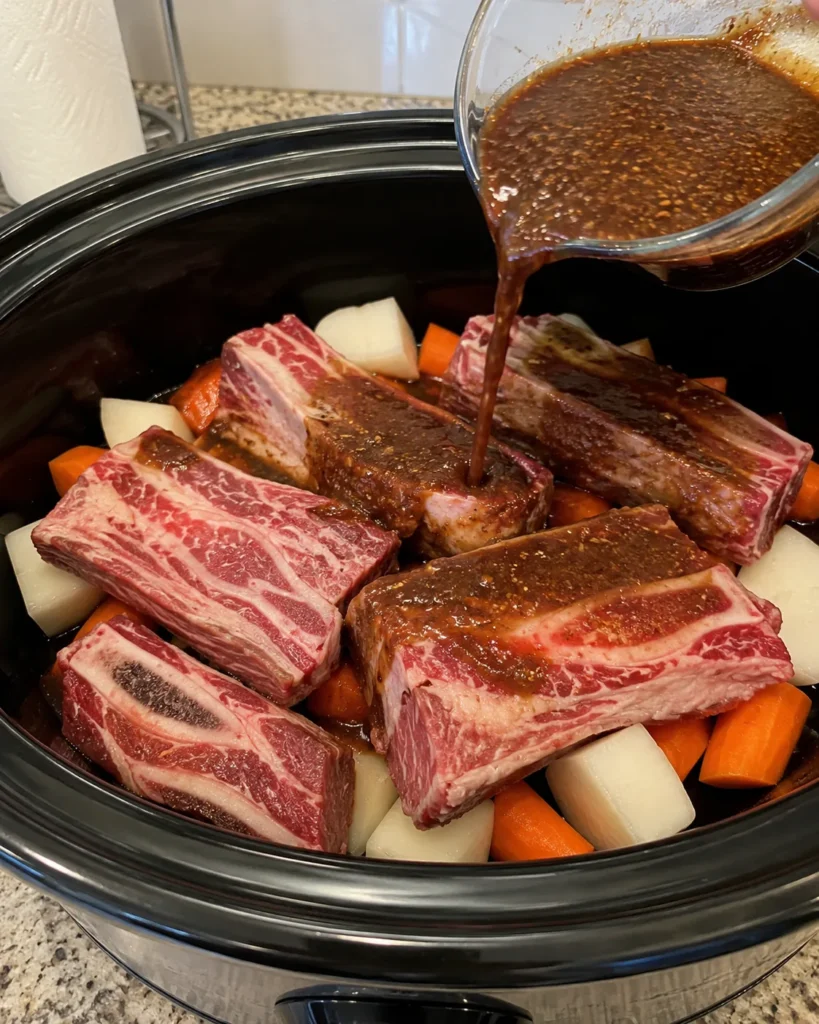
- Load the cooker. Put large chunks of carrot and daikon in a 6-quart slow cooker. Arrange the ribs over them and pour in the sauce, turning the meat once to coat.
- Cook. Cover and cook Slow Cooker Korean Short Ribs for 8–9 hours on LOW. Avoid repeatedly lifting the lid. Start checking near eight hours if the ribs are smaller.
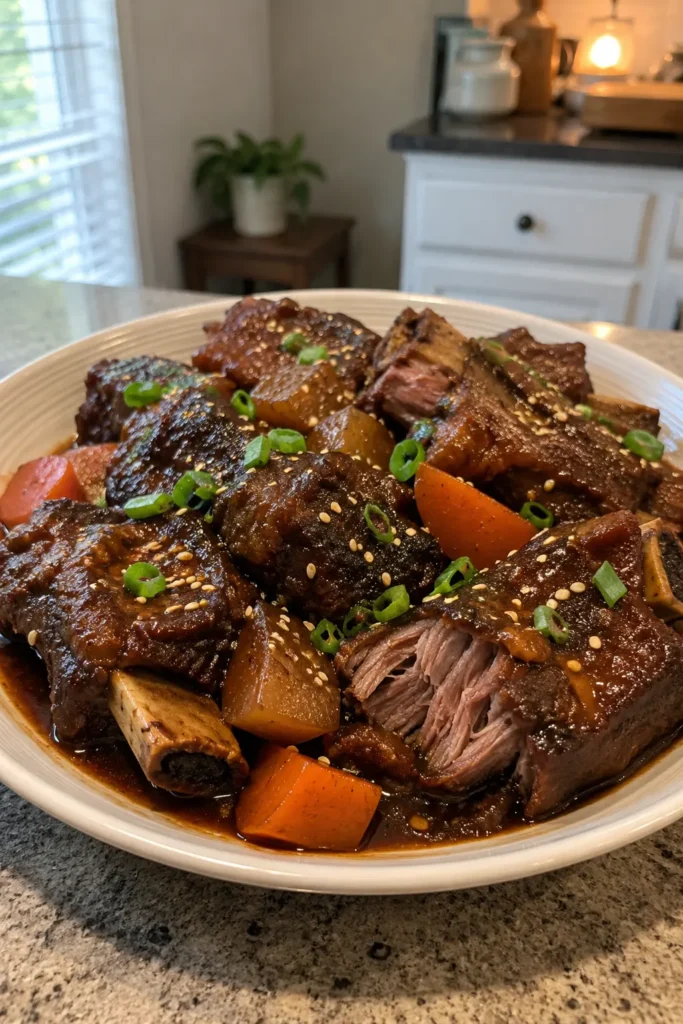
- Check tenderness. A fork should enter the thickest meat easily and the beef should pull from the bone with little resistance. The USDA Safe Minimum Internal Temperature Chart lists 145°F plus a 3-minute rest for whole beef cuts, although a braising cut such as short ribs generally needs more cooking to achieve its tender texture.
- Finish the sauce. Transfer the ribs and vegetables to a platter. Skim visible fat. For a stronger, glossier sauce, simmer 1½–2 cups cooking liquid for 5–10 minutes, then spoon it over the beef.
- Serve. Add sliced scallions and toasted sesame seeds. Serve hot with rice.
Tips, Mistakes, and Substitutions
Choose thick English-cut ribs rather than thin flanken-cut BBQ ribs. Thin ribs are better suited to quick cooking and may become overly soft during a long braise.
Do not add unnecessary broth. Slow cookers retain steam, and the ribs release liquid as they cook. Too much liquid produces a weak sauce.
If the sauce tastes too salty, dilute it with unsalted broth or water before adding extra sugar. Soy-sauce brands vary considerably in sodium.
Asian pear is ideal, but ripe Bosc pear works well. Tamari can replace soy sauce when appropriate, but check the label carefully if gluten avoidance matters.
Serving Ideas and Variations
Serve Slow Cooker Korean Short Ribs over steamed rice with sautéed spinach, cucumber salad, broccoli, or green beans.
For another slow-cooked beef dinner, readers can try The Crockpot Birria Taco. It has a completely different Mexican-inspired chile profile, but it uses the same useful principle of giving a collagen-rich beef cut enough time to become tender.
For another hands-off family dinner, Crockpot Butter Chicken expands the slow-cooker collection with tender chicken and a creamy, warmly spiced tomato sauce.
For a little heat, whisk 1–2 teaspoons gochujang into the sauce. For more vegetables, add sliced mushrooms during the final 60–90 minutes so they remain tender without disappearing into the braising liquid.
Storage, Freezing, and Reheating – Slow Cooker Korean Short Ribs
Refrigerate the beef, vegetables, and sauce in shallow airtight containers within two hours. Properly chilled cooked beef leftovers are generally best used within 3–4 days, and USDA Leftovers and Food Safety recommends reheating leftovers to 165°F.
Freeze the meat with enough sauce to keep it moist for up to about 3 months, then thaw overnight in the refrigerator.
Reheat Slow Cooker Korean Short Ribs in a saucepan, microwave, or 325°F oven until the center reaches 165°F. USDA guidance does not recommend reheating cold leftovers directly in a slow cooker because they can warm too gradually.
Nutrition and Dietary Notes
Nutrition values are estimates based on the listed ingredients, yield, and assumed serving size. Values vary according to brands, substitutions, and portion size.
One serving is about one large meaty short rib with vegetables and some sauce. Rib size, edible meat, rendered fat, and sauce consumption vary, so these figures are practical estimates rather than laboratory measurements.
| Nutrient | Estimated Amount per Serving | Main Source |
| Calories | 610 kcal | Beef, sugar, sauce |
| Protein | 38 g | Beef |
| Carbohydrates | 31 g | Pear, sugar, vegetables |
| Fiber | 3 g | Pear, carrots, daikon |
| Total sugars | 21 g | Pear, brown sugar |
| Added sugars | 12 g | Brown sugar, mirin |
| Total fat | 36 g | Beef, sesame oil |
| Saturated fat | 14 g | Beef |
| Sodium | 1,350 mg | Soy sauce |
| Iron | About 4 mg | Beef |
Beef provides most of the protein, fat, saturated fat, iron, and zinc. Pear, carrots, daikon, onion, and sugar provide most carbohydrates and sugars, while the vegetables contribute some fiber. Soy sauce is the main sodium source.
To reduce sodium, use lower-sodium soy sauce and replace part with unsalted broth; the sauce will taste gentler. For more fiber, serve brown rice and extra vegetables. To reduce saturated fat, trim large exterior fat deposits and remove hardened fat from chilled sauce.
The major allergen is soy. Some soy sauces contain wheat, so verify labels when serving someone who avoids gluten. Check mirin and broth labels for individual allergen needs.
Frequently Asked Questions – Slow Cooker Korean Short Ribs
Can I cook the ribs on HIGH?
Yes. Cook for roughly 5–6 hours on HIGH and begin checking tenderness early, although LOW generally gives a gentler braise.
Do I need to sear the ribs first?
No. Searing adds browned flavor, but Slow Cooker Korean Short Ribs still develop a rich sauce without that extra step.
Why are my short ribs still tough?
They likely need more time. Continue cooking until a fork enters easily and the meat separates from the bone with little effort.
Can I make this one day ahead?
Yes. Chilling makes the rendered fat easy to lift from the sauce. Reheat the ribs and sauce to 165°F before serving.
Can I make Slow Cooker Korean Short Ribs without Asian pear?
Yes. Use a ripe Bosc pear or a sweet apple. The flavor changes slightly, but the sauce still gets fruit sweetness and body.
Are these the same as Korean BBQ short ribs?
No. Korean BBQ galbi commonly uses thinner ribs for grilling, while this version uses thick English-cut ribs and a long moist braise.
Final Thoughts – Slow Cooker Korean Short Ribs
Slow Cooker Korean Short Ribs are a patient-cooking recipe rather than a complicated one: build the soy-pear sauce, let thick ribs soften slowly, then finish them with glossy cooking liquid. Rice and crisp vegetables make the rich beef feel balanced and complete.
Print
Slow Cooker Korean Short Ribs
- Prep Time: 20 minutes
- Cook Time: 480–540 minutes
- Total Time: 500–560 minutes
- Yield: 6 servings 1x
- Category: Main Dish
- Method: Slow Cooker
- Cuisine: Korean-Inspired
Description
Tender bone-in beef short ribs slow-cooked in a savory-sweet Korean-inspired sauce made with soy sauce, Asian pear, garlic, ginger, mirin, sesame oil, carrots, and daikon.
Ingredients
4 pounds bone-in English-cut beef short ribs
¾ cup low-sodium soy sauce
½ cup low-sodium beef broth
1 Asian pear, peeled and roughly chopped
½ medium yellow onion, roughly chopped
⅓ cup packed brown sugar
¼ cup mirin
2 tablespoons rice vinegar
6 garlic cloves
1 tablespoon freshly grated ginger
1 tablespoon toasted sesame oil
½ teaspoon black pepper
3 medium carrots, cut into large chunks
8 ounces daikon radish, cut into large chunks
4 scallions, thinly sliced
1 tablespoon toasted sesame seeds
Instructions
1. Pat the short ribs dry and trim away only large pieces of exterior fat.
2. Add soy sauce, broth, Asian pear, onion, brown sugar, mirin, rice vinegar, garlic, ginger, sesame oil, and black pepper to a blender.
3. Blend until mostly smooth.
4. Place carrot and daikon chunks in the bottom of a 6-quart slow cooker.
5. Arrange the short ribs over the vegetables.
6. Pour the sauce over the ribs and turn them once to coat.
7. Cover and cook on LOW for 8–9 hours.
8. Begin checking the ribs near the 8-hour mark. They are ready when a fork slides easily into the meat and the beef pulls from the bone with little resistance.
9. Transfer the ribs and vegetables to a serving platter.
10. Skim visible fat from the cooking liquid.
11. Optional: simmer 1½–2 cups of cooking liquid in a saucepan for 5–10 minutes for a stronger, glossier sauce.
12. Spoon sauce over the ribs and garnish with scallions and toasted sesame seeds.
13. Serve hot with rice and vegetables.
Notes
Use fully thawed ribs before slow cooking.
English-cut short ribs are preferred over thin flanken-cut ribs for this long cooking method.
Avoid adding additional broth unless needed because the slow cooker retains moisture.
Asian pear may be replaced with ripe Bosc pear.
For added heat, mix 1–2 teaspoons gochujang into the sauce.
Check soy sauce, mirin, broth, and gochujang labels when gluten or allergen concerns apply.
Nutrition
- Serving Size: About 1 large meaty short rib with vegetables and sauce
- Calories: 610 kcal
- Sugar: 21g
- Sodium: 1350mg
- Fat: 36g
- Saturated Fat: 14g
- Unsaturated Fat: 0g
- Trans Fat: 0g
- Carbohydrates: 31g
- Fiber: 3g
- Protein: 38g
- Cholesterol: 0g