
Ham and Cheese Pocket Sandwiches wrap smoky ham, tangy mustard, and melted sharp Cheddar inside warm, flaky dough. They are simple enough for a weekday lunch but satisfying enough to serve with soup, salad, or vegetables for an easy family meal.
The sealed edges keep the filling neatly contained, making these pockets useful for lunchboxes, after-school snacks, casual gatherings, and make-ahead meals. Save or print this recipe so the ingredient amounts and sealing tips are easy to find when you need a quick baked sandwich.
Quick These Ham and Cheese Pocket Sandwiches Snapshot
| Detail | Information |
|---|---|
| Prep time | 15 minutes |
| Cook time | 13–16 minutes |
| Total time | About 35 minutes |
| Servings | 8 |
| Serving size | 1 pocket sandwich |
| Difficulty | Beginner-friendly |
| Cooking method | Oven-baked |
| Flavor | Savory, smoky, cheesy, and lightly tangy |
| Texture | Flaky outside with a soft, melted center |
| Best for | Lunches, snacks, meal prep, and casual dinners |
Table of Contents
Table of Contents
Why You’ll Love These Ham and Cheese Pocket Sandwiches
- Straightforward ingredients: Refrigerated dough removes the need to mix, knead, or proof homemade bread dough.
- Neat and portable: Crimped edges help contain the ham and melted cheese.
- Quick preparation: The pockets require approximately 15 minutes of hands-on work.
- Flexible filling: Different cheeses, mustards, vegetables, and cooked meats work well.
- Family-friendly flavor: Mild ham and Cheddar create a familiar combination.
- Freezer-friendly: Baked pockets can be frozen individually and reheated when needed.
Ingredients and Why They Matter
Refrigerated crescent-dough sheets create a buttery, flaky shell without the preparation required for homemade pastry. Look for solid sheets rather than perforated crescent triangles when possible. When using perforated dough, pinch the seams firmly before cutting it.
Thinly sliced fully cooked ham folds easily and allows the pockets to close without becoming bulky. Sharp Cheddar brings a noticeable cheese flavor, while Dijon mustard adds acidity that balances the richness.
| Main Ingredient | Purpose | Nutrition Contribution | Best Substitution |
| Crescent dough | Forms the flaky outer pocket | Carbohydrates and fat | Refrigerated pizza dough |
| Cooked ham | Adds savory, smoky flavor | Protein and sodium | Cooked turkey |
| Sharp Cheddar | Creates the melted center | Protein, fat, and calcium | Monterey Jack |
| Dijon mustard | Adds moisture and tang | Flavor with minimal calories | Honey mustard |
| Egg | Helps the crust brown | Protein and fat | Milk or cream wash |
| Sesame seeds | Adds light crunch | Unsaturated fat and minerals | Poppy seeds |
Choose ham labeled fully cooked or ready to eat. Pat unusually moist slices with a paper towel because extra moisture can make the bottom dough soft.
Shredded cheese melts more evenly than thick cheese slices. Keep it in the center of each pocket and away from the seams, where escaping cheese can interfere with the seal.
How to Make Ham and Cheese Pocket Sandwiches
1. Prepare the oven and pan
Preheat the oven to 375°F. Line a large baking sheet with parchment paper or lightly grease it.
Unroll both chilled dough sheets on a clean work surface. Cold dough is easier to handle, so return it to the refrigerator for a few minutes if it becomes sticky or overly soft.
2. Cut the dough
Cut each sheet into four similar rectangles, giving you eight pieces in total. Gently stretch each rectangle until it measures approximately 5 by 7 inches.
Avoid making the center paper-thin. Dough that is too thin may split as the cheese melts and the trapped steam expands.
3. Add mustard and filling
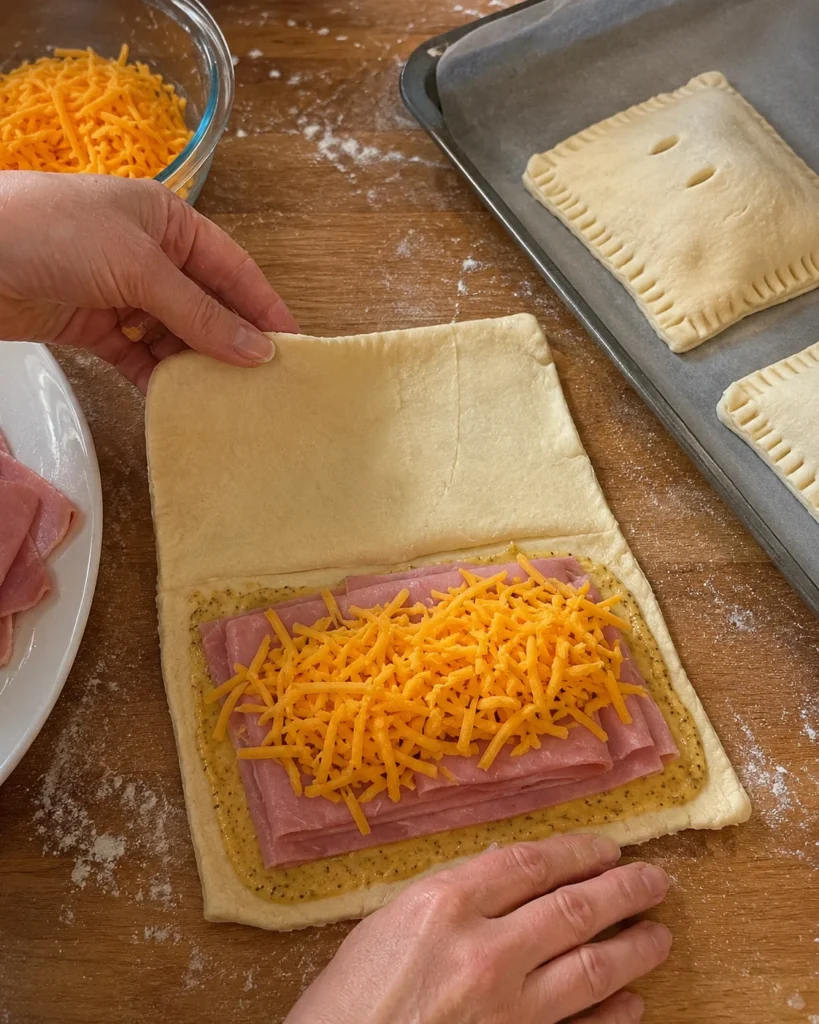
Spread about ¾ teaspoon Dijon mustard over one half of each rectangle, leaving a clean ½-inch border. Add approximately 1 ounce of folded ham and 3 tablespoons shredded Cheddar.
Keep the filling in a compact mound rather than spreading it to the edges. Overfilling is the most common reason Ham and Cheese Pocket Sandwiches burst during baking.
4. Fold and seal
Fold the empty half of the dough over the filling. Press around the filling gently to remove large air pockets, then press the edges together.
Crimp all three open sides with a fork. Check for gaps, especially at the corners, and pinch them closed with your fingers.
5. Vent and brush
Transfer the pockets to the prepared baking sheet, leaving about 2 inches between them. Cut two small slits in the top of each pocket so steam can escape.
Whisk the egg with 1 tablespoon water. Brush a thin coating over the tops and sprinkle with sesame seeds when desired. Wash hands, tools, and work surfaces after contact with raw egg, following the FDA’s egg-safety recommendations.
6. Bake and cool
Bake Ham and Cheese Pocket Sandwiches for 13–16 minutes, rotating the pan halfway through if your oven browns unevenly.
They are ready when the tops are deeply golden, the bottoms are lightly browned, and the seams appear dry and set. Let the pockets cool for at least 5 minutes because the cheese inside will be considerably hotter than the crust.
Tips, Mistakes, and Substitutions – Ham and Cheese Pocket Sandwiches
Keep the dough refrigerated until you are ready to work. Warm crescent dough becomes stretchy and sticky, making clean sealing more difficult.
Use modest filling portions. Extra ham and cheese may sound appealing, but overloaded pockets frequently split or develop soggy centers.
Leave a clean border around the filling. Mustard, ham, or shredded cheese caught in the seam prevents the dough from bonding properly.
Do not skip the vents. Two small openings release steam without allowing much filling to escape.
For a breadier crust, substitute refrigerated pizza dough. Roll it about ⅛ inch thick and expect the pockets to require a few additional minutes in the oven. Puff pastry can also work, producing a crisp, delicate shell, though it is richer and may shed more crumbs.
Swiss, Monterey Jack, Colby, mozzarella, and Gruyère are useful cheese substitutions. Mozzarella gives a milder, stretchier center, while Swiss or Gruyère creates a nuttier flavor.
Serving Ideas and Variations
Serve Ham and Cheese Pocket Sandwiches with tomato soup, a leafy salad, steamed vegetables, fresh fruit, or crunchy cucumber slices. A small dish of mustard, ranch dressing, or tomato sauce works well for dipping.
For a lunch built around another warm handheld sandwich, try this Tuna Melt Wrap. Its creamy tuna filling offers a useful alternative when you want a stovetop recipe rather than a baked pocket.
Add finely chopped cooked broccoli for extra texture, or use cooked turkey with Monterey Jack for a milder variation. A thin layer of drained pineapple creates a sweet-and-savory version, but use it sparingly to avoid making the dough wet.
For a more substantial family dinner, these Cheesy Sweet Chilli Chicken Flatbreads use another convenient combination of bread, cooked meat, sauce, and melted cheese.
For breakfast pockets, add a small spoonful of firmly scrambled egg and reduce the ham slightly. The filling must be cool before it touches the dough. You can also explore this Veggie Breakfast Burrito for a breakfast option with eggs, beans, potatoes, and vegetables.

Storage, Freezing, and Reheating – Ham and Cheese Pocket Sandwiches
Cool leftover Ham and Cheese Pocket Sandwiches before placing them in an airtight container. Refrigerate them within two hours and use them within three to four days. This timeline agrees with the government’s general guidance for cooked leftovers.
For freezing, place cooled pockets on a tray until firm, then wrap them individually and transfer them to a freezer-safe bag. Freeze for up to two months for the best texture. Thaw overnight in the refrigerator or reheat from frozen.
Reheat refrigerated pockets in a 350°F oven for 8–10 minutes or in an air fryer at 325°F for 4–6 minutes. Frozen pockets may need 15–20 minutes in the oven.
A microwave is convenient, but it softens the crust. Reheat one pocket in short intervals and allow it to rest briefly so the temperature distributes evenly. USDA guidance recommends reheating leftovers to 165°F, measured in the center with a food thermometer.
Nutrition and Dietary Notes – Ham and Cheese Pocket Sandwiches
Nutrition values are estimates based on the listed ingredients, yield, and assumed serving size. Values vary according to brands, substitutions, and portion size.
One serving is one pocket made with approximately 1 ounce of ham, ¾ ounce of Cheddar, and one-eighth of the dough. Each pocket is estimated to provide about 350 calories, 14 grams of protein, 27 grams of carbohydrates, 1 gram of fiber, 21 grams of fat, 10 grams of saturated fat, 6 grams of total sugars, 3 grams of added sugars, and 850 milligrams of sodium.
| Nutrient | Estimated Amount per Serving | Main Source |
| Calories | 350 | Dough, cheese, and ham |
| Protein | 14 g | Ham and Cheddar |
| Carbohydrates | 27 g | Crescent dough |
| Fiber | 1 g | Enriched wheat flour |
| Total sugars | 6 g | Dough and mustard |
| Added sugars | 3 g | Prepared dough |
| Total fat | 21 g | Dough, cheese, and egg wash |
| Saturated fat | 10 g | Cheddar and dough |
| Sodium | 850 mg | Ham, cheese, dough, and mustard |
| Calcium | About 180 mg | Cheddar cheese |
Ham and Cheddar supply most of the protein. The dough and cheese provide much of the fat, while the ham, cheese, mustard, and prepared dough contribute sodium. Cheddar is also the primary calcium source.
These pockets function best as a light meal or substantial snack. Add fruit or vegetables to provide more fiber and volume.
To reduce sodium, choose lower-sodium ham and cheese, though the flavor will be less salty. To increase fiber, use whole-wheat pizza dough, which creates a chewier crust. To reduce saturated fat, use reduced-fat Cheddar, understanding that it may melt less smoothly.
Major allergens include wheat, milk, and egg. Some packaged dough products may also contain soy, so check labels when allergies are a concern.
Frequently Asked Questions – Ham and Cheese Pocket Sandwiches
Can I prepare Ham and Cheese Pocket Sandwiches ahead?
Yes. Assemble them up to six hours ahead, cover the baking sheet tightly, and refrigerate. Brush on the egg wash immediately before baking so the surface does not become sticky.
Why did my pockets open in the oven?
They were probably overfilled, insufficiently sealed, or missing steam vents. Keep the border clean, press the edges firmly, and crimp with a fork.
Can I use sliced cheese instead of shredded cheese?
Yes. Tear thin slices into smaller pieces and keep them away from the edges. Thick slices melt more slowly and can make the filling feel uneven.
Can these be cooked in an air fryer?
Yes. Arrange a few pockets in a single layer and air-fry at 350°F for approximately 8–10 minutes. Check early because air-fryer models vary.
How do I keep the bottoms from becoming soggy?
Use dry ham, avoid watery additions, preheat the oven fully, and cool the baked pockets on a wire rack. Parchment also helps prevent sticking without trapping as much grease as a heavily oiled pan.
Can I leave out the mustard?
Yes. Leave it out or replace it with a thin layer of mayonnaise, honey mustard, or softened cream cheese. Avoid using too much sauce because excess moisture weakens the bottom crust.
Final Thoughts – Ham and Cheese Pocket Sandwiches
Ham and Cheese Pocket Sandwiches turn a familiar sandwich filling into a warm, portable meal with crisp golden edges and a creamy center. Careful portioning, firm crimping, and two small steam vents are the simple details that produce the neatest results.
Print
Ham and Cheese Pocket Sandwiches
- Prep Time: 15 minutes
- Cook Time: 15 minutes
- Total Time: 35 minutes
- Yield: 8 pocket sandwiches 1x
- Category: Lunch
- Method: Baking
- Cuisine: American
Description
Flaky baked pocket sandwiches filled with fully cooked ham, sharp Cheddar cheese, and tangy Dijon mustard. These portable sandwiches are easy to assemble and bake until golden with a warm, melted center.
Ingredients
2 refrigerated crescent-dough sheets, 8 ounces each
2 tablespoons Dijon mustard
8 ounces thinly sliced fully cooked ham
6 ounces sharp Cheddar cheese, shredded
1 large egg
1 tablespoon water
1 teaspoon sesame seeds, optional
Instructions
1. Preheat the oven to 375°F and line a large baking sheet with parchment paper.
2. Unroll the chilled crescent-dough sheets and cut each sheet into four rectangles, creating eight rectangles in total.
3. Gently stretch each dough rectangle to approximately 5 by 7 inches without making the center too thin.
4. Spread about 3/4 teaspoon Dijon mustard over one half of each rectangle, leaving a clean 1/2-inch border around the edges.
5. Place approximately 1 ounce of folded ham and 3 tablespoons of shredded Cheddar in a compact mound over the mustard.
6. Fold the empty half of the dough over the filling and gently press around the filling to remove large air pockets.
7. Press the open edges together, then crimp all three open sides firmly with a fork. Pinch any gaps closed.
8. Transfer the pockets to the prepared baking sheet, leaving about 2 inches between them.
9. Cut two small steam vents in the top of each pocket.
10. Whisk the egg with 1 tablespoon of water. Brush a thin layer over each pocket and sprinkle with sesame seeds if desired.
11. Bake for 13 to 16 minutes, rotating the pan halfway through if needed, until the tops are deeply golden, the bottoms are lightly browned, and the seams look dry and set.
12. Cool for at least 5 minutes before serving because the melted cheese filling will be hot.
Notes
Keep the crescent dough refrigerated until you are ready to use it because cold dough is easier to shape and seal.
Use fully cooked ham and pat unusually moist slices dry before assembling the pockets.
Keep the mustard, ham, and cheese away from the edges so the seams seal properly.
Do not overfill the pockets because excess filling can cause the dough to split or the cheese to leak.
Refrigerate cooled leftovers in an airtight container for 3 to 4 days.
Freeze cooled pockets individually for up to 2 months.
Reheat refrigerated pockets in a 350°F oven for 8 to 10 minutes or in an air fryer at 325°F for 4 to 6 minutes.
Reheat leftovers until the center reaches 165°F.
Nutrition
- Serving Size: 1 pocket sandwich
- Calories: 350 kcal
- Sugar: 6g
- Sodium: 850mg
- Fat: 21g
- Saturated Fat: 10g
- Unsaturated Fat: 8g
- Trans Fat: 0g
- Carbohydrates: 27g
- Fiber: 1g
- Protein: 14g
- Cholesterol: 55mg