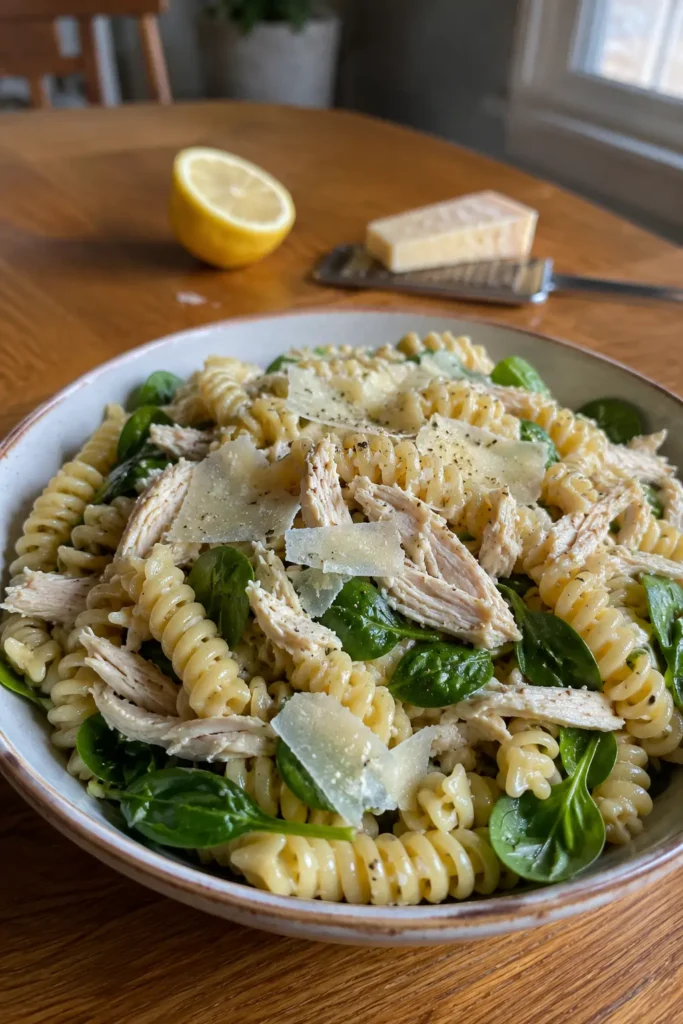
If a jar of sunshine could be tossed with pasta, it would taste a lot like this Lemon Parmesan Chicken Pasta Salad. Tender rotini, juicy chicken, and ribbons of baby spinach get coated in a bright lemon-garlic vinaigrette, then finished with plenty of freshly grated parmesan.
It’s the kind of recipe that solves several problems at once: lunch for the week, a potluck side that travels well, or a light dinner on a warm evening when turning on the oven sounds unappealing. And because it leans on rotisserie chicken, there’s no grill required.
Save or print this one before pasta salad season gets busy — it’s the version you’ll reach for again.
Quick Recipe Snapshot
| Recipe Detail | Information |
|---|---|
| Prep time | 15 minutes |
| Cook time | 12 minutes |
| Resting or cooling time | 15–30 minutes |
| Total time | About 40 minutes |
| Servings | 6 |
| Estimated serving size | About 1½ cups |
| Difficulty | Easy |
| Main cooking method | Boil and toss (no-cook assembly) |
| Flavor profile | Bright, tangy, savory, garlicky |
| Texture profile | Tender pasta, juicy chicken, silky greens |
| Best occasion | Potlucks, meal prep, warm-weather dinners |
| Make-ahead friendly | Yes, up to 24 hours |
| Freezer friendly | No |
Table of Contents
- Why You’ll Love This Lemon Parmesan Chicken Pasta Salad
- The Flavor and Texture Compass
- What Makes This Recipe Work
- Ingredients You’ll Need
- Ingredient Notes and Easy Swaps
- How to Make Lemon Parmesan Chicken Pasta Salad
- Beginner Tips for Best Results
- Common Mistakes and How to Fix Them
- Easy Variations
- What to Serve With Lemon Parmesan Chicken Pasta Salad
- Make-Ahead Instructions
- How to Store Lemon Parmesan Chicken Pasta Salad
- Can You Freeze Lemon Parmesan Chicken Pasta Salad?
- How to Refresh Leftovers
- Nutrition and Health Details
- Print and Save This Recipe
- Frequently Asked Questions
- Final Thoughts
Why You’ll Love This Lemon Parmesan Chicken Pasta Salad
- The lemon-garlic vinaigrette is bright and light — no heavy mayo weighing things down.
- Rotisserie chicken makes it genuinely fast, with no grill or skillet required.
- It holds up beautifully for 24 hours, so it’s a natural for potlucks and meal prep.
- Its familiar flavors make it a practical option for family-style meals.
- Every ingredient is a regular grocery-store find.
- It works as a light main dish or a generous side, depending on what’s next to it.
The Flavor and Texture Compass
The needle here points firmly toward bright and tangy. Fresh lemon juice and zest lead, backed by savory parmesan, a whisper of garlic, and just enough honey to round out the citrus’s sharp edge.
Texture-wise, expect tender pasta with a slight bite, juicy shreds of chicken, and spinach that softens into silky ribbons as the salad sits. As it chills, the lemon mellows and the parmesan melts subtly into the dressing — which is why a final squeeze of lemon before serving wakes everything back up.
What Makes This Lemon Parmesan Chicken Pasta Salad Work
Two small decisions carry this recipe. First, the pasta is cooled before dressing. Hot pasta drinks up vinaigrette like a sponge, leaving the salad dry an hour later; cooling it first means the dressing coats rather than disappears.
Second, the dressing follows a classic vinaigrette ratio — roughly two parts oil to one part lemon juice — with Dijon acting as the glue that keeps oil and juice from separating. The honey isn’t there for sweetness so much as balance, softening the acidity so the lemon tastes bright instead of harsh.
Ingredients You’ll Need
A few quality choices matter here. Grate parmesan from a block if you can — it clings to the pasta and dissolves into the dressing far better than the shelf-stable powdered kind. And use a fresh lemon, since you need the zest as well as the juice.
Rotisserie chicken is the easy route, but any cooked chicken works, including leftovers from these spicy jalapeño chicken breasts if you’d like a little heat running through the salad.
Ingredient Guide
| Ingredient | Culinary Purpose | Nutrition Contribution | Practical Substitution |
|---|---|---|---|
| Rotini pasta (12 oz) | Spirals trap dressing in every ridge | Main carbohydrate source, some fiber and iron | Farfalle or cavatappi, 1:1; whole-wheat adds fiber and a nuttier chew |
| Cooked chicken (3 cups) | Makes it a meal; savory backbone | Primary protein source | Grilled or baked chicken breast; slightly less sodium than rotisserie |
| Parmesan (¾ cup) | Salty, savory depth; thickens the dressing slightly | Protein, calcium, notable sodium | Pecorino Romano — sharper and saltier, so reduce added salt |
| Baby spinach (3 cups) | Color, freshness, gentle texture contrast | Fiber, potassium, vitamin A, folate | Arugula for a peppery bite; kale holds up longer but is chewier |
| Olive oil (⅓ cup) | Dressing body; carries the lemon and garlic flavors | Main fat source, mostly unsaturated | Avocado oil, 1:1, with a milder flavor |
| Fresh lemon (zest + juice) | The defining brightness | Small amount of vitamin C | Bottled juice works in a pinch but loses the fragrant zest entirely |
| Dijon mustard (2 tsp) | Emulsifies the vinaigrette | Minor sodium | Whole-grain mustard; slightly milder and adds texture |
| Honey (1 tsp) | Balances the lemon’s acidity | The recipe’s only added sugar | Maple syrup, 1:1 |
Ingredient Notes and Easy Swaps
Whole-wheat or chickpea pasta: a 1:1 swap that raises fiber (and protein, in the chickpea case). Expect a firmer, slightly grainier texture and check the package time — legume pastas overcook quickly.
Arugula for spinach: same amount, peppery instead of mild, and it wilts faster, so add it just before serving if making ahead.
Skipping the honey: the salad still works, but the lemon will taste noticeably sharper. Taste before deciding.
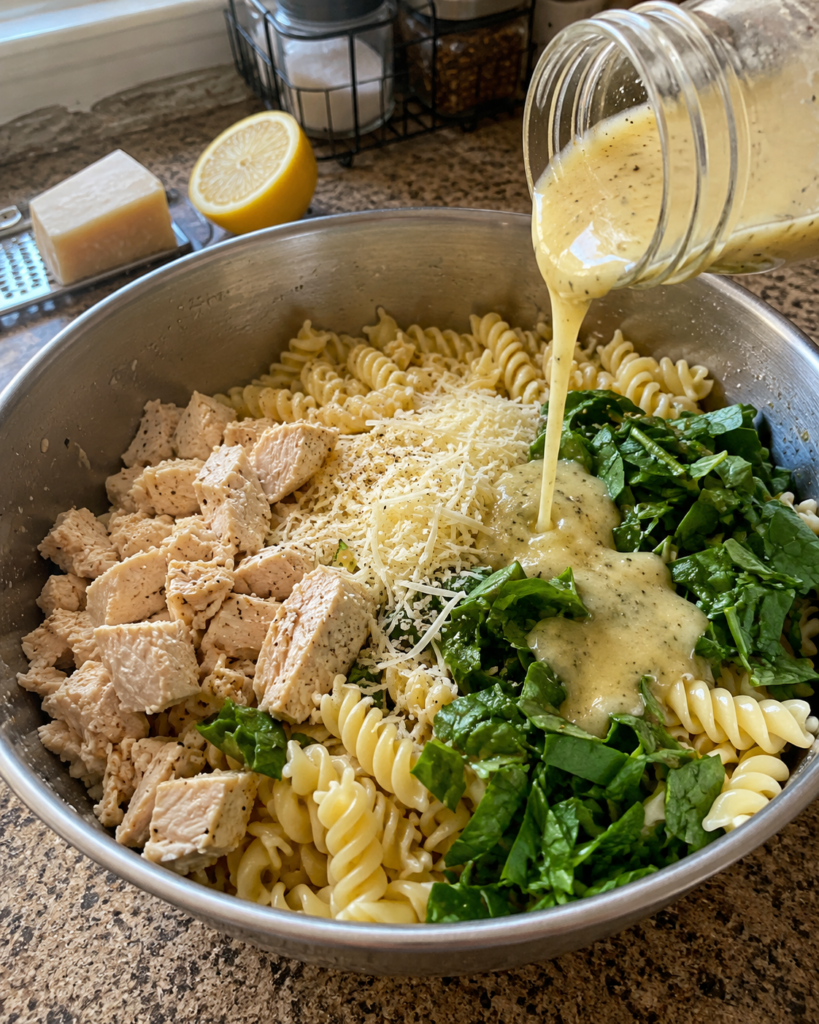
How to Make Lemon Parmesan Chicken Pasta Salad
- Boil the pasta. Cook 12 oz rotini in well-salted boiling water until al dente — tender with a slight bite at the center, usually a minute shy of the package time. Drain and rinse briefly under cool water to stop the cooking, then let it drain thoroughly. Wet pasta dilutes the dressing.
- Whisk the dressing. In a jar or small bowl, combine ⅓ cup olive oil, the zest of 1 lemon, 3–4 tablespoons lemon juice, 2 teaspoons Dijon, 1 teaspoon honey, 2 minced garlic cloves, ½ teaspoon salt, and ¼ teaspoon pepper. Whisk or shake until it looks slightly creamy and unified rather than separated.
- Prep the chicken. Chop or shred 3 cups of cooked chicken into bite-size pieces. If you’re cooking chicken from raw, cook it to an internal temperature of 165°F, confirmed with a thermometer per FoodSafety.gov guidance, and let it rest before chopping.
- Toss everything together. In a large bowl, combine the cooled pasta, chicken, chopped spinach, and ½ cup of the parmesan. Pour the dressing over and toss until no dry pasta remains and everything glistens lightly.
- Chill and finish. Refrigerate 15–30 minutes so the flavors settle in. Taste — chilling softens lemon flavor — and adjust with a squeeze of juice or pinch of salt. Top with the remaining parmesan and serve cold.
Beginner Tips for Best Results
- Salt the pasta water generously. It’s your only chance to season the pasta itself.
- Cool the pasta before dressing it. This is the single biggest texture-saver in the recipe.
- Zest before juicing. A whole lemon is far easier to zest than a squeezed half.
- Taste after chilling. Cold mutes both salt and acid, so the final adjustment matters.
- Hold back a little dressing if making ahead, then toss it in just before serving for a freshly dressed feel.
- Cut everything roughly the same size so each forkful gets a bit of everything.
Common Mistakes and How to Fix Them – Lemon Parmesan Chicken Pasta Salad
Mistake: The salad tastes dry the next day.
Why it happens: pasta keeps absorbing dressing as it sits.
How to prevent it: cool the pasta first and reserve a few spoonfuls of dressing.
How to rescue it: a drizzle of olive oil and a fresh squeeze of lemon revives it in seconds.
Mistake: The lemon flavor vanished in the fridge.
Why it happens: cold temperatures dull acidity.
How to prevent it: always taste and re-season after chilling.
How to rescue it: add lemon juice a teaspoon at a time until it brightens.
Mistake: Mushy pasta.
Why it happens: cooking to the full package time, then letting residual heat keep working.
How to prevent it: pull it a minute early and rinse briefly in cool water.
How to rescue it: this one can’t be undone — but the flavor will still be good.
Easy Variations
- Artichoke version: fold in a drained 14-oz can of quartered artichoke hearts for a tangy, Mediterranean lean.
- Higher protein: add a drained can of white beans or an extra cup of chicken; the servings get more filling without changing the method.
- Lower sodium: use plain baked chicken instead of rotisserie and cut the added salt to ¼ teaspoon — a meaningful drop, since seasoned rotisserie birds carry significant salt.
- Pop of color: halved cherry tomatoes or quick-pickled onions, like these Mexican red pickled onions, add tang and brightness.
- Creamier finish: whisk 2 tablespoons of mayonnaise into the vinaigrette; richer, with a bit more fat per serving.
What to Serve With Lemon Parmesan Chicken Pasta Salad
As a main, it needs little more than fresh fruit or sliced cucumbers alongside. As a cookout side, it’s lovely next to spinach feta turkey burgers or grilled vegetables.
For something baked to round out a picnic spread, a pan of moist cornbread is a friendly match. And if you’re building a lemony menu from start to finish, lemon poppyseed scones make a fitting sweet ending. Craving a warm pasta night instead? This Tuscan mushroom pasta scratches that itch.
Make-Ahead Instructions
The whole salad can be assembled up to 24 hours ahead and refrigerated in a covered container. For the best texture, reserve about a quarter of the dressing and the final parmesan topping, then add both just before serving. The spinach will soften as it sits — pleasant to most, but add it last-minute if you prefer it perky.
How to Store Lemon Parmesan Chicken Pasta Salad
Refrigerate leftovers in an airtight container for 3 to 4 days, in line with USDA leftover guidance. Because this contains chicken, don’t leave it at room temperature longer than 2 hours — or 1 hour if it’s above 90°F, as at a summer picnic. At gatherings, keep the bowl nested in ice. Discard it if it smells sour or the chicken looks slimy.
Can You Freeze Lemon Parmesan Chicken Pasta Salad?
Freezing isn’t recommended. Dressed pasta turns mushy when thawed, spinach collapses into a watery layer, and the vinaigrette separates. This is a fresh-and-chilled recipe — happily, it comes together fast enough that freezing isn’t much of a loss.
How to Refresh Leftovers
No reheating needed — this salad is served cold. If leftovers look dry, toss with a small drizzle of olive oil and a squeeze of lemon, then a pinch of salt if it tastes flat. Give it a few minutes out of the fridge before eating; slightly-less-cold pasta salad simply tastes brighter.
Nutrition and Health Details – Lemon Parmesan Chicken Pasta Salad
The following nutrition information is an estimate based on the listed ingredients, recipe yield, and assumed serving size. Exact values vary by brand, substitutions, portion size, and preparation.
How the Estimate Was Calculated
Numbers are based on 6 servings of about 1½ cups each, using USDA FoodData Central values for the core ingredients and typical grocery labels for rotisserie chicken. Optional garnishes are excluded. The biggest swing factors are the chicken (rotisserie carries far more sodium than plain baked breast) and the parmesan style.
Estimated Nutrition and Practical Context
| Nutrition Measure | Estimated Amount per Serving | Practical Context |
|---|---|---|
| Calories | ~490 | A moderate light-main portion; the pasta, chicken, and olive oil each contribute meaningfully |
| Protein | ~33 g | Mostly from the chicken, with pasta and parmesan adding the rest |
| Total carbohydrates | ~44 g | Almost entirely from the pasta |
| Dietary fiber | ~2 g | From pasta and spinach; whole-wheat pasta would roughly double this |
| Total sugars | ~3 g | Mostly naturally occurring; the honey adds about 1 g per serving |
| Added sugars | ~1 g | The honey is the only added-sugar source |
| Total fat | ~18 g | Mostly olive oil, which is largely unsaturated |
| Saturated fat | ~4 g | Primarily from the parmesan and chicken |
| Sodium | ~570 mg | Rotisserie chicken, parmesan, and added salt; plain chicken lowers this noticeably |
| Cholesterol | ~70 mg | From the chicken and cheese |
| Potassium | ~480 mg | Chicken, pasta, and spinach |
| Calcium | ~130 mg | Mostly from the parmesan |
| Iron | ~1.5 mg | Enriched pasta and spinach |
Protein and Fullness
At roughly 33 grams per serving, this is a genuinely protein-dense dish for a pasta salad, thanks to a full pound of chicken across six servings. That protein, alongside the fat in the dressing, makes each portion reasonably satisfying as a stand-alone lunch. To push it higher, add white beans or an extra cup of chicken.
Carbohydrates, Fiber, and Sugars
The pasta supplies nearly all the carbohydrates, and as written it’s a refined grain. Swapping in whole-wheat rotini is the simplest fiber upgrade, though it brings a nuttier flavor and firmer chew. Sugar is barely a factor here — one teaspoon of honey across the whole bowl.
Fat and Saturated Fat
Olive oil does most of the work, which keeps the fat profile weighted toward unsaturated sources. The parmesan contributes most of the saturated fat, and it also contributes most of the savory depth — trimming it will lighten the numbers and the flavor together, so reduce gradually if you try.
Sodium
Three ingredients drive sodium: seasoned rotisserie chicken, parmesan, and the added salt. Using plain baked chicken and holding the added salt until after tossing — then salting to taste — gives you the most control, since the cheese seasons the salad more than you’d expect.
Vitamins and Minerals
The spinach brings vitamin A, folate, and potassium; the parmesan is a modest calcium source; and enriched pasta contributes iron. The fresh lemon adds a small amount of vitamin C.
Portion and Meal Context
One serving works as a light complete meal on its own. As a potluck side next to burgers or grilled meats, a half portion is plenty, which also halves everything in the table above. Adding a piece of fruit or extra vegetables alongside makes for an easy, more rounded plate.
Dietary and Allergen Considerations
This recipe contains wheat (gluten) and milk (parmesan). Gluten-free pasta is a workable swap, though textures vary by brand. There is no way to make the parmesan optional without changing the dish’s identity, so dairy-free eaters may prefer a different salad. Always verify every product label when cooking for someone with a food allergy — a single substitution doesn’t guarantee an allergen-free result.
Practical Nutrition Adjustments
- Whole-wheat pasta: roughly doubles fiber; firmer texture, nuttier taste; same cook method.
- Plain baked chicken instead of rotisserie: cuts roughly 150–200 mg sodium per serving; flavor is milder, so taste and adjust seasoning.
- Add a can of white beans: boosts protein and fiber; makes servings larger, so the per-serving numbers shift accordingly.
- Extra vegetables (cherry tomatoes, cucumber): adds volume, potassium, and freshness with minimal calories; the salad gets juicier, so drain tomatoes briefly.
- Reduce parmesan to ½ cup: lowers saturated fat and sodium; the dressing will taste noticeably less savory.
Food-Safety Notes
If cooking chicken from raw, use a food thermometer and cook to 165°F. Wash hands and surfaces after handling raw poultry, and keep it separate from ready-to-eat ingredients. Once assembled, keep the salad at 40°F or below, follow the 2-hour rule at gatherings, and use refrigerated leftovers within 3–4 days.
Nutrition Perspective
This salad lands in comfortable middle ground: solid protein, moderate calories, and a dressing built mostly on olive oil. Its saltiest, richest ingredient — the parmesan — is also its signature flavor, so adjust it based on the result you want at the table, not out of obligation.
Frequently Asked Questions – Lemon Parmesan Chicken Pasta Salad
Can I use rotisserie chicken for this pasta salad?
Yes — it’s actually the recommended shortcut. Any fully cooked chicken works, including grilled, baked, or leftover breast meat. Just note that seasoned rotisserie birds add more sodium than plain cooked chicken.
What’s the best pasta shape for Lemon Parmesan Chicken Pasta Salad?
Short shapes with ridges or curves — rotini, farfalle, or cavatappi — hold the vinaigrette best. Long strands like spaghetti don’t distribute dressing or mix-ins evenly.
Can I make it the night before?
Yes, up to 24 hours ahead. Reserve a little dressing and the final parmesan to add just before serving, and taste for lemon and salt after chilling.
How long does it last in the fridge?
3 to 4 days in an airtight container, per USDA leftover guidelines. Refresh with olive oil and lemon juice before serving.
Can I freeze it?
No — the pasta turns mushy, the spinach goes watery, and the dressing separates once thawed.
Why does my pasta salad taste bland after chilling?
Cold dulls both acidity and salt. It’s normal. Taste the chilled salad and add a squeeze of lemon and a small pinch of salt until it brightens back up.
Is Lemon Parmesan Chicken Pasta Salad served warm or cold?
Cold or cool room temperature. It’s designed as a chilled dish, which is exactly what makes it so useful for meal prep and potlucks.
Final Thoughts – Lemon Parmesan Chicken Pasta Salad
Lemon Parmesan Chicken Pasta Salad earns a permanent spot on the summer list because it’s fast, bright, and better organized than most of us are by Wednesday. Remember the one tip that matters most: cool the pasta before dressing it, and taste again after chilling. Get those two moments right and the rest takes care of itself.
Print
Lemon Parmesan Chicken Pasta Salad
- Prep Time: 15 minutes
- Cook Time: 12 minutes
- Total Time: 40 minutes
- Yield: 6 servings 1x
- Category: Salad, Main Dish
- Method: Boil and Toss
- Cuisine: American
Description
This Lemon Parmesan Chicken Pasta Salad tosses tender rotini, juicy chicken, and baby spinach in a bright lemon-garlic vinaigrette with plenty of parmesan. Make-ahead friendly and ready in about 40 minutes.
Ingredients
12 oz rotini pasta
3 cups cooked chicken, chopped or shredded (about 1 lb; rotisserie works well)
3 cups baby spinach, roughly chopped
3/4 cup freshly grated parmesan, divided
1/3 cup extra-virgin olive oil
Zest of 1 large lemon
3–4 tablespoons fresh lemon juice (about 1 large lemon)
2 teaspoons Dijon mustard
1 teaspoon honey
2 garlic cloves, minced
1/2 teaspoon salt
1/4 teaspoon black pepper
Instructions
1. Cook the rotini in well-salted boiling water until al dente, about 1 minute less than the package time. Drain, rinse briefly under cool water, and drain thoroughly.
2. Whisk the olive oil, lemon zest, lemon juice, Dijon, honey, garlic, salt, and pepper in a jar or small bowl until slightly creamy.
3. Chop the cooked chicken into bite-size pieces. If cooking from raw, cook to 165°F internal and rest before chopping.
4. In a large bowl, combine the pasta, chicken, spinach, and 1/2 cup parmesan. Pour the dressing over and toss until evenly coated.
5. Chill 15-30 minutes. Taste and adjust lemon and salt, top with the remaining 1/4 cup parmesan, and serve cold.
Notes
Cool the pasta before dressing so it doesn’t absorb the vinaigrette; taste again after chilling since cold dulls lemon and salt.
Storage: Refrigerate in an airtight container up to 3-4 days. Don’t leave at room temperature more than 2 hours (1 hour above 90°F).
Freezing: Not recommended — pasta and spinach lose texture and the dressing separates.
Serving: Served cold. Refresh leftovers with a drizzle of olive oil and a squeeze of lemon.
Food safety: Cook chicken from raw to 165°F internal temperature per USDA guidance; keep the finished salad at 40°F or below.
Nutrition information is an estimate and will vary according to brands, substitutions, and serving size.
Nutrition
- Serving Size: About 1 1/2 cups
- Calories: 490 kcal
- Sugar: 3g
- Sodium: 570mg
- Fat: 18g
- Saturated Fat: 4g
- Unsaturated Fat: 13g
- Trans Fat: 0g
- Carbohydrates: 44g
- Fiber: 2g
- Protein: 33g
- Cholesterol: 70mg
Print and Save This Lemon Parmesan Chicken Pasta Salad
Pasta salads like this one earn their keep in the rotation — print it now or bookmark it so it’s within reach the next time a potluck invitation or a hot Tuesday evening calls for something cold, bright, and already figured out.